
PetExpress Blog
Bringing Your Dog or Cat to Sri Lanka
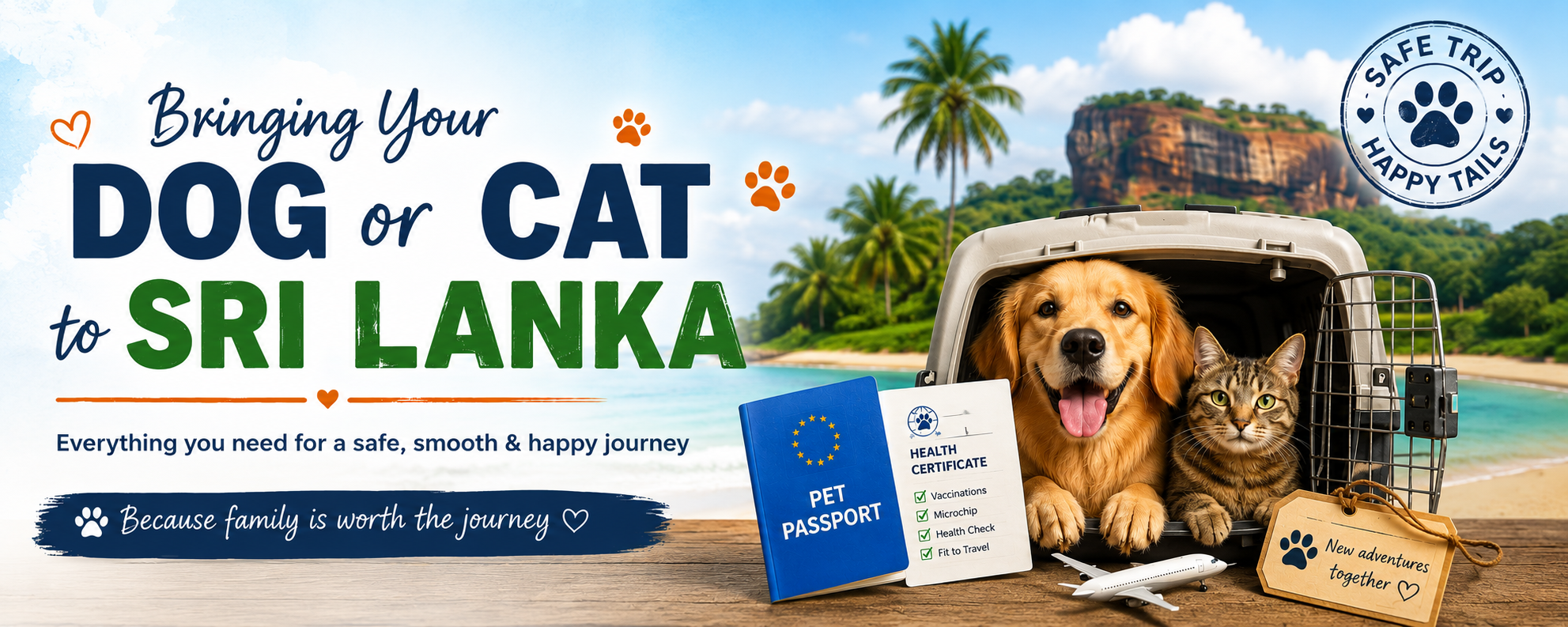
For most families, the emotional part of the journey is easy to understand. They want their dog or cat beside them when they move to Sri Lanka, return home, retire, begin a new posting or reunite with family. The regulatory part is less obvious. Several different systems must agree before the animal can be released.
The Sri Lankan Department of Animal Production and Health, usually called DAPH, controls the import permit and veterinary entry conditions. The airline controls whether the animal can be accepted on the chosen flight and in the proposed travel crate. Animal Quarantine officers inspect the pet and its documents at the port of entry. Sri Lanka
Customs and the cargo terminal complete the remaining clearance steps.
A successful arrival depends on all of them. An import permit by itself is not a flight booking. A flight booking by itself is not permission to enter Sri Lanka. A healthy pet can still be delayed if a microchip number is missing from a report or a treatment falls outside the required period.
Begin with the import permit
Sri Lankan law requires an import permit before an animal is brought into the country. DAPH currently directs dog and cat applications through its online application channel and publishes separate veterinary health requirements for dogs and cats.
The application should be treated as the start of the file, not the final step. The permit may include conditions that must be satisfied before departure and documents that must be presented on arrival. Read the issued permit itself, not only a website summary or an old checklist. The permit is the case-specific instruction for that animal and journey.
Pet Express recommends starting the assessment as early as possible, particularly when:
- the pet has incomplete vaccination records
- the pet has recently changed ownership
- the microchip was implanted after earlier vaccinations
- the journey involves a transit country
- the pet is young, elderly, snub-nosed or under veterinary care
- the owner plans to travel during a busy holiday period
- the flight will arrive outside normal government or cargo-office hours
The current application method, forms and contact channels can change. Check DAPH's official import page at the time of application.
The 2026 veterinary requirements for dogs
DAPH's requirements effective from 1 January 2026 state that an imported dog must be over one and a half months of age and identified with an ISO-compliant microchip. The microchip number must appear clearly on the relevant records, including vaccination certificates and blood-test reports.
The dog must be fully vaccinated and up to date against:
- rabies
- canine distemper
- canine parvovirus
- canine infectious hepatitis
- leptospirosis
For a dog under three months of age, the published requirement also refers to the vaccination status of the mother. In practice, airline minimum-age policies, rabies vaccination rules and the animal's fitness for travel may make the realistic travel age later than the minimum stated in the import document.
The 2026 dog requirements also call for negative tests for the following conditions, completed within one month of the expected departure:
- leishmaniasis, using an accepted PCR, ELISA or IFAT method
- heartworm antigen, using an accepted PCR, ELISA or IFAT method
- heartworm microfilaria, using an accepted concentration or filtration method such as a Knott's test
DAPH states that a test for a specific disease may not be required when the exporting country is officially recognised as free from that disease. Do not assume that a country is exempt because the disease is uncommon. The status must be acceptable to the authority handling the application.
The dog must also receive treatment against internal and external parasites within fourteen days before departure. The treatment must be certified by a registered veterinarian.
Finally, an International Veterinary Health Certificate must be issued by the competent veterinary authority of the exporting country within ten days before export. It must confirm that the dog is clinically healthy and fit to travel, correctly microchipped, appropriately vaccinated and compliant with the required testing.
The 2026 veterinary requirements for cats
The current cat requirements also state a minimum age of over one and a half months and require an ISO-compliant microchip. The microchip number must be recorded consistently across the cat's documents.
The cat must be fully vaccinated and up to date against:
- rabies
- feline calicivirus
- feline herpesvirus type 1
- feline panleukopenia virus
For cats under three months of age, the published document refers to the mother's vaccination status. The same practical caution applies here. A kitten may satisfy a stated minimum age while still being too young for the airline, the vaccination sequence or the journey itself.
Cats must be treated against internal and external parasites within fourteen days before departure, with the treatment certified by a registered veterinarian.
An International Veterinary Health Certificate must be issued by the competent veterinary authority of the exporting country within ten days before export. The certificate must confirm that the cat is clinically healthy and fit to travel, has a valid ISO-compliant microchip and has been vaccinated as required.
The current DAPH cat guideline does not list the same leishmaniasis and heartworm blood-test section that appears in the dog guideline. The final permit and any later official instruction still take priority, so the file must be checked against the version in force when the cat travels.
Choose how the pet will travel
Depending on the airline, route, animal and owner's itinerary, a dog or cat may travel in one of several ways.
In the passenger cabin
Some airlines accept small pets in the cabin on selected routes. The airline sets the carrier dimensions, weight limit, booking process and number of animals allowed. Cabin acceptance does not remove Sri Lanka's import and arrival requirements.
As accompanied or excess baggage
The pet travels on the owner's passenger flight but is checked through the airline's baggage system under the carrier's live-animal procedure. Not every airline or route offers this option.
As manifested air cargo
The pet travels under an Air Waybill through the airline's cargo system. This is often required when the pet travels without its owner, when the airline does not accept pets as baggage, or when the destination process requires cargo handling.
The best option is not simply the cheapest label. It depends on airline policy, aircraft type, seasonal temperature controls, transit handling, arrival time, document requirements and the animal's individual needs.
The travel crate must be accepted before flight day
The crate is the pet's cabin for the journey. It must be large enough for the animal to stand naturally, sit erect, turn around and lie in a normal position. It must also be strong, escape-resistant, properly ventilated and fitted with secure water arrangements.
IATA publishes Container Requirement 1 for domestic dogs and cats. IATA does not certify or approve commercial crate brands, so the accurate description is an IATA-compliant crate, not an IATA-certified crate.
Do not wait until airport check-in to discover that:
- the pet's ears touch the roof
- the top and bottom are held together only by plastic clips
- the wheels have not been removed or made inoperable
- the door pins do not engage securely
- the water bowl cannot be filled from outside
- ventilation has been blocked by labels or bedding
- a nervous or strong dog can distort the door
Measure the animal while standing naturally and have the completed crate checked well before travel. Early crate training also gives the pet time to treat the space as familiar rather than as a last-minute restraint.
What happens before the aircraft departs
A good arrival is usually created by a final pre-flight audit. Before the pet leaves the country of origin, Pet Express checks that the arrival file is complete and that the Sri Lankan clearance plan matches the flight.
The final pack normally includes, as applicable:
- the original Sri Lankan import permit
- vaccination records
- microchip record
- laboratory reports
- parasite-treatment record
- the officially issued International Veterinary Health Certificate
- owner and consignee identification
- Air Waybill or airline booking details
- flight itinerary
- any declaration or authority letter required for clearance
The documents that travel with the pet should be protected, clearly identified and accessible to the airline and arrival agent. Keep a complete digital copy as well. Photographs of every page can be invaluable if a document is delayed or separated from the file.
What happens when the pet lands at Colombo Airport
Bandaranaike International Airport is the main international arrival point for pet dogs and cats entering Sri Lanka by air. The exact sequence depends on whether the pet arrives as baggage or manifested cargo, but a cargo arrival commonly involves several connected steps.
1. The flight and cargo records are confirmed
The arrival agent confirms that the aircraft has landed, the live-animal consignment has been transferred to the cargo terminal and the airline documents are available for release processing.
2. The pet and documents are presented for animal-quarantine inspection
Animal Quarantine officers inspect the veterinary file and may verify the animal's identity and condition. DAPH states that imported live animals and their documents are inspected at the port of entry. When the consignment complies, Animal Quarantine provides the recommendation needed for Customs clearance.
3. Customs and terminal formalities are completed
The Air Waybill, consignee details, government approvals, cargo charges and Customs procedures are processed. The steps can vary according to the transport method and the way the shipment was booked.
4. The pet is released
When the animal and documents are fully compliant, same-day release is often possible. It is never sensible to promise an exact release time before the aircraft lands. Cargo availability, flight delays, inspection findings, Customs processing, government-office hours and payment systems can all affect the day.
The best arrival update is an honest one. Families should know when the flight has landed, when the pet has reached the terminal, when inspection is complete and when the animal is physically ready to leave the airport.
What the thirty-day quarantine requirement means
Sri Lanka's Animal Diseases Act and DAPH guidance state that every imported animal is subject to a minimum thirty-day quarantine period. This does not automatically mean that every compliant family pet spends thirty days in a central quarantine building.
For many personal pet arrivals, the animal may be released after airport clearance under the quarantine or surveillance conditions stated in the permit and declaration, commonly at the owner's residence. The owner may be required to keep the animal at the declared address, monitor its health, permit inspection and report illness or death during the period.
This arrangement is not a blanket guarantee. DAPH retains authority over quarantine conditions. A pet may be detained, examined further, sampled or subjected to other instructions if the documents, identity or health status raise concern. The wording of the issued permit and the direction of the Animal Quarantine Officer govern the individual case.
The mistakes that create avoidable delays
After years of handling international pet arrivals, the problems that cause the most anxiety are often small on paper and serious at the airport.
The import permit was obtained, but the final certificate does not match it
A changed flight date, altered route or different consignee may need to be reflected in the file. Do not assume the permit remains usable after a major itinerary change.
The microchip number appears differently across documents
Compare every digit. A handwritten number should be especially clear.
The health certificate was issued outside the permitted period
The certificate is time-sensitive. Rebooking can invalidate an otherwise correct document.
Dog blood tests were completed too early
The 2026 dog guideline places the listed tests within one month of expected departure, subject to any recognised disease-free exemption.
The parasite treatment is outside the fourteen-day period
The treatment date, product and veterinary certification should all be recorded.
The crate is unsuitable
A rejected crate can stop the journey even when the permit and veterinary work are perfect.
The owner has not arranged the arrival clearance
A pet should not be placed on an aircraft while the consignee, agent, original documents and government-arrival process remain uncertain.
Ready to plan your pet's arrival?
Send Pet Express the pet's vaccination records, microchip details, country of departure, proposed arrival date and flight information. We will review the Sri Lankan arrival requirements and explain the next practical step.